
What is semi truck advertising?
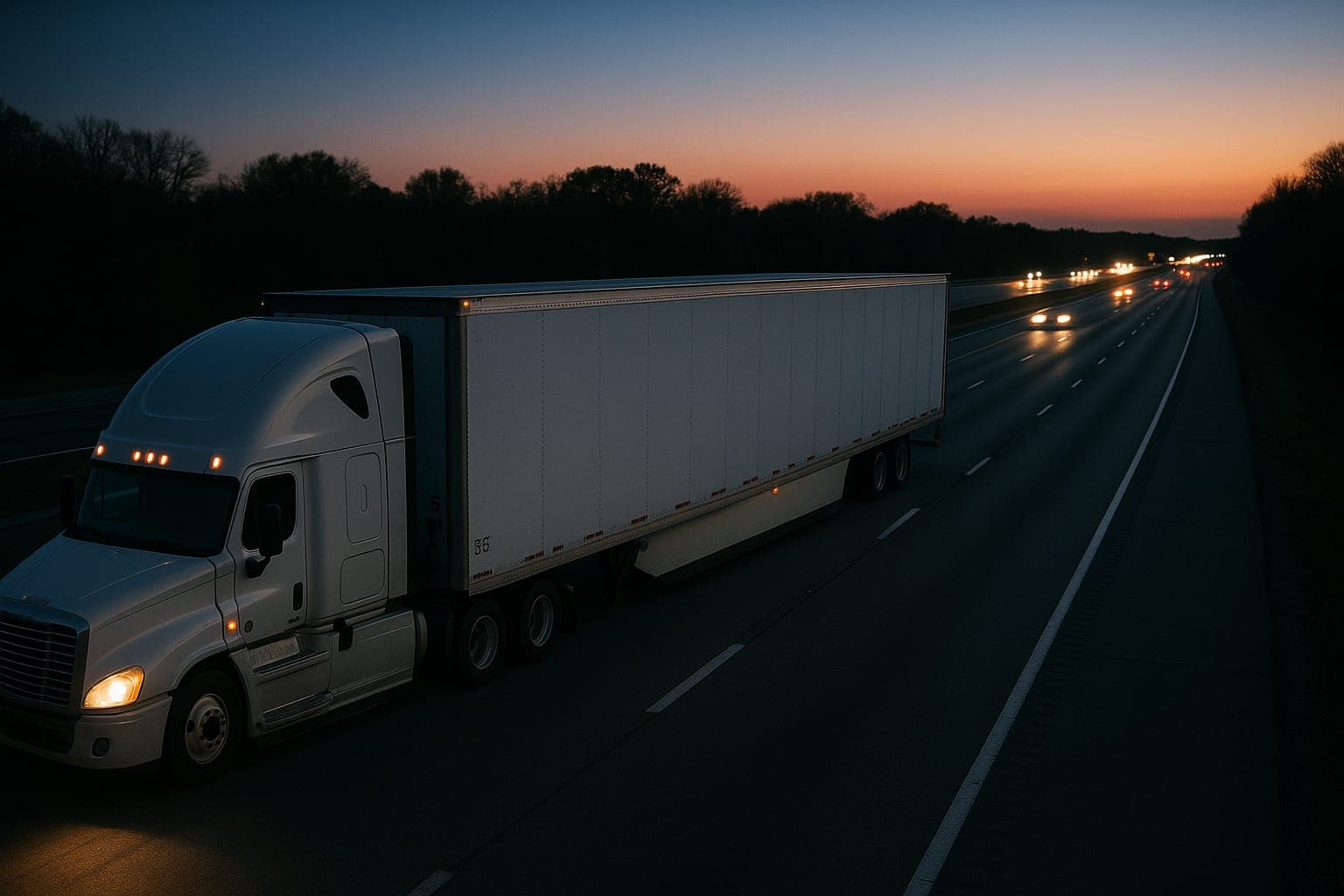
Semi truck advertising puts your ad on the side of a working 53-foot trailer, pulled by a tractor on its normal freight runs. We bolt a frame to the trailer and fit your printed banner inside it, so the ad rides along on loads the trucker hauls anyway. Nothing touches the paint.
It is not a billboard trailer, the small trailer built only to carry a sign. If you want a truck that drives only to show an ad, see mobile billboard trucks.
Why is a 53-foot trailer the biggest panel on the road?
A 53-foot trailer is the longest side you pass on the highway. The OAAA, the out-of-home industry association, sizes trailer vans at about 28 to 53 feet, and we use the top of that range. Your banner runs on both sides, and the rear doors are an option.
It also covers the most ground. The average combination truck in the US, the federal term for a tractor pulling a trailer, drove 55,276 miles in 2024, about 4,600 a month. A single-unit truck such as a box truck drove 10,880 (FHWA). That is about five times the miles.
Where do semi trucks with ads drive?
Semi trucks with ads drive the interstate corridors between cities, plus the warehouse districts and distribution centers at each end.
Those corridors are where trailers spend their miles, so one banner passes through several cities, and the traffic between them, in a single week.
Traffic also slows, which gives drivers more time beside the panel. ATRI's 2026 list of the worst truck bottlenecks, led by I-294 in Chicago, puts the average rush-hour truck speed at 33.2 mph.
Who should advertise on semi trucks?
Semi truck advertising fits advertisers who sell across a state or a region and want their name on the roads between their markets.
- Regional brands with locations in several cities along one interstate: dealer groups, banks, credit unions, store chains.
- Statewide law firms. Legal services was the largest out-of-home category of 2025 (OAAA). See truck advertising for law firms.
- Consumer products. Brands launching in a new retail chain have used trucks around the new stores in their first weeks on shelf (Modern Retail). A trailer carries that launch across a region.
- Campaigns for statewide races and ballot questions. Political panels need a clear paid-for-by line under federal and state disclaimer rules.
Truckers approve every ad. Injury firms should lead with car crashes or workers' comp, not truck accidents, which truckers are likely to refuse. A business that serves a few zip codes does better with box truck advertising.
Can I add an ad on the back of the trailer?
Yes. The rear panel is optional and sits on the trailer doors, facing the driver directly behind the truck. On the highway that car can follow for miles, and in stop-and-go traffic the doors fill its windshield.
Use it for the shortest version of your message, the name and phone number, set larger than on the sides. We price it on the same call.
How are trailer routes chosen?
We match your campaign to trailers whose regular lanes already cover your region, and you see those lanes before you commit.
- 01
Name your region
The cities, the state or the corridor you care about, for example two cities and the interstate between them.
- 02
We find steady lanes
We look for trailers that run the same corridor again and again. A predictable lane is worth more than random broker freight.
- 03
Approve lanes and proof
You review the lanes, then the proof. Nothing prints until you approve it, and the ad is usually on the road within three weeks.
- 04
See it running
Install photos on day one, dated check-in photos every month and a route log. GPS tracking in the frames is next.
Semi trailer or box truck: which should I choose?
Choose a trailer for regional reach and a box truck for local repetition. You can also run both: trailers between your cities and box trucks inside them.
| Compare | Box truck | 53-foot trailer |
|---|---|---|
| Length | 16 to 26 feet | 53 feet |
| Where it drives | Neighborhoods, downtown, parking lots, job sites | Interstates and highways between cities |
| Average miles a year | 10,880 (single-unit trucks) | 55,276 (combination trucks) |
| Panels | Both sides | Both sides, optional rear |
| Best for | Local services, law firms, clinics, store openings | Regional brands, statewide law firms, consumer products, campaigns |
| Price | Flat monthly price per truck | Flat monthly price per truck, higher than a box truck |
Both come with the same proof and pricing model. See what moves the number on the pricing page.
Questions
How much does semi truck advertising cost?
A flat monthly price per truck, plus a one-time production charge for the frame and the first banner. Trailers cost more per month than box trucks, and you get the exact number on a short call. Campaigns run three months or longer.
What is the difference between a billboard trailer and trailer advertising?
A billboard trailer or billboard truck exists only to carry a sign, and dedicated static billboard trucks rent for about $800 to $2,400 a day. We put a frame on a working 53-foot trailer that is already hauling freight, and you pay by the month.
Can I choose the exact highway?
You choose the region and see the lanes before you commit. Working trailers follow their freight, so we sell lanes as driven, not one fixed road every day.
Will truckers carry any ad?
No. Every trucker approves every ad and can block whole categories, like politics, alcohol or cannabis. One business per category rides on each truck.
Does the frame damage the trailer?
No. The banner sits in a bolted frame, not a wrap, so nothing touches the paint. The frame stays clear of the carrier's name, the USDOT number, the lights and the reflective tape, as federal rules require.
How do I know my trailer ad is running?
You get install photos on day one, dated check-in photos every month and a route log. GPS tracking in the frames is next.
Keep reading
- How truck advertising works
- Box truck advertising
- Mobile billboard trucks
- Mobile billboard cost
- Law firms
- Pricing
Sources
- OAAA, Truckside and Fleet Displays (2022)
- FHWA, Highway Statistics 2024, Table VM-1: annual miles by vehicle type
- ATRI, Top 100 Truck Bottlenecks (February 2026, 2025 data)
- OAAA, Out of Home Advertising Revenue Reaches Record $9.46 Billion (2026): top categories of 2025
- Modern Retail, Why mobile billboards are driving interest from DTC brands (2023)
- 11 CFR 110.11, political advertising disclaimers
- Millennial Trucking, trailer advertising revenue for fleets (June 2026)
- 49 CFR 390.21, marking of commercial motor vehicles
- 49 CFR 393.11, lamps and reflective devices
- Dash Two, How much does billboard advertising cost
- LED Truck Media, Mobile billboard advertising cost 2026