
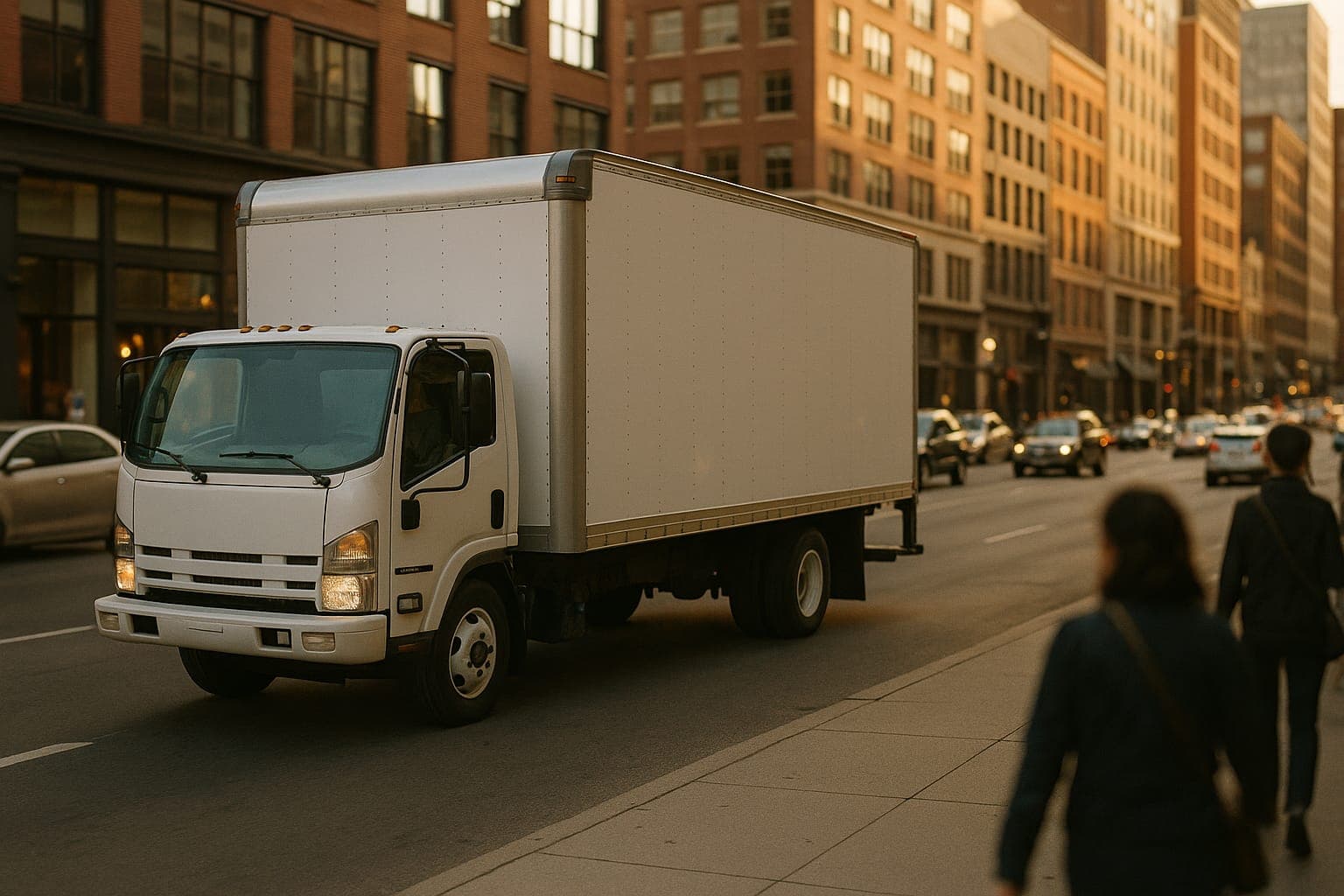
What is truck advertising?
Truck advertising is paid ad space on the side of a truck. The ad moves with the truck, so people see it at red lights, in traffic, in parking lots and on the highway. People also call it truck side advertising, ads on trucks, an ad truck or a mobile billboard.
It is a form of out-of-home advertising, the same family as billboards, bus ads and transit posters. Out-of-home was a $9.46 billion channel in the US in 2025, according to the OAAA, the industry's trade group. Transit was its fastest-growing format in the second quarter of 2026, up 23.9 percent. The OAAA does not report truck ads as their own line, so there is no reliable figure for truck advertising alone.
There are two ways to buy it. You can rent a truck that exists only to carry ads, or you can buy space on trucks that are already out working. Pass By Media does the second.
Billboard truck or working truck: what is the difference?
A dedicated billboard truck drives only to show ads, while a working truck carries your ad as it does its normal job. The first is usually sold by the hour or the day. The second is sold by the month.
A dedicated truck lets you choose the route. The OAAA notes that on dedicated truck programs the advertiser designates the routing. That suits events, grand openings and one-day pushes. Static billboard trucks run about $800 to $2,400 a day and LED trucks about $1,200 to $3,600 a day, according to Dash Two. At day rates, a full month adds up fast.
A working truck drives the same streets and lanes again and again, because that is its job. You do not steer it. You pick trucks whose regular routes cover your area, and you see those routes before you commit. You give up control of the route and get a full month of daily driving for one monthly price. Our guide to mobile billboard trucks compares the two side by side.
Box truck or 53-foot trailer: which one fits?
Choose a box truck to reach one city or metro area, and a 53-foot trailer to reach the highways between cities. The two formats travel very different distances. The average US single-unit truck, the class that includes box trucks, drove 10,880 miles in 2024. The average combination truck, a tractor pulling a trailer, drove 55,276 miles, according to the Federal Highway Administration.
| Detail | Box truck | 53-foot trailer |
|---|---|---|
| Size | 16 to 26 feet long | 53 feet long, the biggest panel on the road |
| Where it drives | City streets, neighborhoods, parking lots and job sites | Interstates and highways between cities |
| Ad space | Both sides | Both sides, with an optional rear panel |
| Average miles a month | About 900 | About 4,600 |
| Best for | Law firms, home services, clinics and store openings | Regional brands, law firms, campaigns and consumer products |
More miles is not always better. A trailer based in your city can spend most of the month in other states. A box truck on local deliveries stays in your market and stops often, and that is what a local business pays for. Read more about box truck advertising and semi truck and trailer advertising.
How does truck side advertising work?
Truck side advertising with Pass By Media works by placing a printed banner in an aluminum frame bolted to the side of the truck. The banner is tensioned inside the frame so it stays flat at highway speed. No adhesive touches the paint. When your message changes, a new banner goes into the same frame in under an hour, so you pay for a new print, not a new install. Here is how frames compare with wraps.
- One business per category on each truck. A law firm never shares a truck with another law firm.
- The trucker approves every ad and can turn down whole categories, such as politics or alcohol.
- You approve the proof before anything is printed.
- The trucker is paid every month for the space, by direct deposit.
- Campaigns run anywhere in the United States, from one city to coast to coast.
How much does truck advertising cost?
Pass By Media charges a flat monthly price per truck, plus a one-time production charge for the frame and the first banner. We do not publish a rate card. The number depends on the truck and the routes, and you get it on a short call. The first ten advertisers get pilot pricing. It is never priced per lead, per call or per case.
- Truck type. A 53-foot trailer costs more per month than a box truck.
- Number of trucks. The price per truck comes down as you add trucks in the same market.
- Campaign length. Longer campaigns get a lower monthly rate.
- Market and routes. Dense, slow city routes are worth more per mile than empty highway.
- Production. A one-time charge per truck. A new banner later is a print charge, not a new install.
| Option | Published price | Source |
|---|---|---|
| Static billboard truck, rented by the day | $800 to $2,400 a day | Dash Two |
| LED billboard truck, rented by the day | $1,200 to $3,600 a day | Dash Two |
| Printed ads on working delivery trucks, through a media broker | $4,200 to $7,600 per truck per four weeks, with a minimum of $5,000 or more per market | Blue Line Media |
See what moves our price, or read the full mobile billboard cost guide for how trucks compare with static billboards.
How do you know your truck ad is running?
You get install photos on day one, dated check-in photos every month, and a route log of the lanes the truck drives. That is the proof we can stand behind today.
We do not sell impression counts we cannot back up. GPS trackers in the frames are the next step. They are not a live feature yet.
To measure response on your side, put something on the banner that appears nowhere else. A separate phone number, a short web address or a QR code all work. Count the calls and visits that come through it, and compare month to month.
Who does truck advertising work best for?
Truck advertising works best for businesses that sell in a defined area and need people to remember a name and a number. Most out-of-home money is local: MAGNA put local sales at 65 percent of US out-of-home ad sales in 2024, in figures published by the OAAA.
- Law firms. Legal services was the largest out-of-home category in the US in 2025, up 21 percent, per the OAAA. A firm name, a practice area and a phone number read in seconds. See truck advertising for law firms.
- Home services. HVAC, plumbing, roofing and pest control. Architects, contractors and engineers entered the OAAA's top 10 categories in the second quarter of 2026. With a frame, the banner can switch from cooling in May to heating in October.
- Clinics and dental offices. Hospitals, clinics and medical centers were the second-largest out-of-home category in 2025. New patients, walk-in hours and one phone number fit a truck panel.
- Retail launches. A brand arriving in stores in a new region can run trailers on the highways between those stores and box trucks near them. Technology and direct-to-consumer companies made up 30 percent of the top 100 out-of-home advertisers in the second quarter of 2026.
- Campaigns. Political and issue campaigns, hiring drives and events with a date. Some truckers decline political ads, so these run on trucks whose owners accept them.
It works less well for an offer that needs a long explanation. People see the panel for a few seconds at a time, often from a moving car.
How to start advertising on a truck
Start with a 15-minute call. Your banner is usually on the road within three weeks of approved artwork.
- 01
Book a call.
Tell us your market, what you sell and when you want to run. We come back within one business day with trucks, routes and a price.
- 02
Pick trucks and routes.
Box trucks for city streets, trailers for the interstates. You see the routes before you commit.
- 03
Approve the proof.
Send your artwork or use our design help. Nothing is printed until you approve it.
- 04
Go on the road.
The banner goes into the frame at the trucker's yard, usually within three weeks of approved artwork.
- 05
See it running.
Install photos on day one, then dated photos and a route log every month.
Keep the design simple: a name, one line and a phone number or web address, in letters big enough to read from the next lane.
Questions
What is truck advertising?
Truck advertising is paid ad space on the side of a truck, so the ad travels wherever the truck drives. Pass By Media puts printed banners in frames on working box trucks and 53-foot trailers.
How much does it cost to advertise on a truck?
Pass By Media charges a flat monthly price per truck, plus a one-time production charge for the frame and the first banner. The price depends on the truck type, the number of trucks, the routes and how long you run, and you get it on a short call.
Is a working truck the same as a mobile billboard truck?
No. A mobile billboard truck drives only to show ads and is usually rented by the day. A working truck hauls real freight on its regular routes and carries your ad for the whole month.
Can I choose where the truck drives?
You choose the trucks, not the turns. We match trucks whose regular routes cover your area, and you see those routes before you commit.
How do I know my ad is on the road?
You get install photos on day one, dated check-in photos every month, and a route log. GPS tracking in the frames is the next step and is not live yet.
Can I change the ad during the campaign?
Yes. The frame holds a banner, not a wrap, so a new banner goes in quickly. You pay for the new print, not a new install.
Will my competitor be on the same truck?
No. Each truck carries one business per category, so a law firm never shares a truck with another law firm.
Keep reading
- Mobile billboard trucks
- Box truck advertising
- Semi truck advertising
- Mobile billboard cost
- Frames vs. wraps
- Law firms
Sources
- OAAA: Out of home advertising revenue reaches record $9.46 billion (2025)
- OAAA: From Coca-Cola to OpenAI, brands are betting bigger on OOH (Q2 2026)
- OAAA: 2024 OOH Facts and Figures, ad spend performance (MAGNA local and national split)
- OAAA: Truckside and fleet displays
- Federal Highway Administration: Highway Statistics 2024, table VM-1
- Dash Two: How much does billboard advertising cost?
- Blue Line Media: Mobile billboard advertising