
What is the difference between a truck wrap and a banner frame?
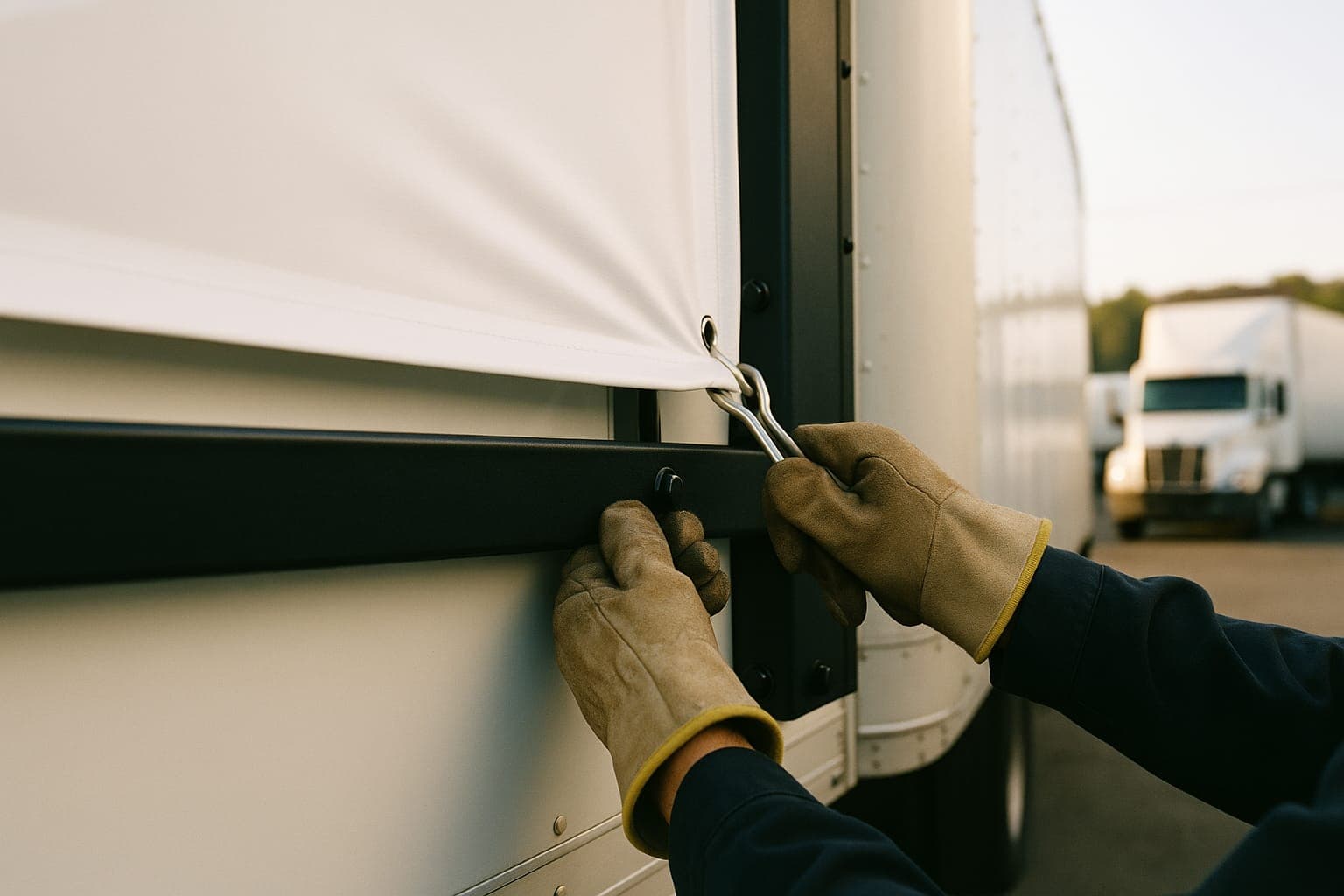
A truck wrap is adhesive vinyl film printed with your design and applied over the paint, while a truck banner frame is a metal frame bolted to the side of the box or trailer that holds a printed banner. The wrap becomes part of the truck's surface. The frame holds a sign that can come out.
That one difference decides the cost, how fast the message can change and what happens to the paint. Vehicle wrap advertising usually means a business wrapping its own vans and trucks. Frames are how Pass By Media puts ads on working trucks that belong to someone else.
Looking to get paid to wrap your car?
We do not take cars, pickups or vans. Our ads go only on box trucks of 16 to 26 feet and on 53-foot trailers. Here is why we skip cars, and how the car wrap scam works.
How much does a truck wrap cost compared with a frame?
A wrap costs more up front and little per month if the design never changes. A designer quoted by ACHR News, an HVAC trade paper, put contractor vehicle wraps at $3,500 to $4,500 per vehicle, with a shelf life of about five years. Spread over 60 months, $3,500 is about $58 a month. For your own van, that is good value.
Those figures are for contractor vehicles, and the cost rises with the area wrapped. A 26-foot box or a 53-foot trailer has far more surface, and we found no reliable published price for wrapping one.
A frame is a one-time production charge for the frame and the first banner. After that, each new message costs only a new print. With Pass By Media, production sits on top of a flat monthly price per truck, and you get both numbers on a short call. See how our pricing works.
How fast can you change the ad?
A banner in a frame can be changed in under an hour at the trucker's yard. The OAAA says truckside banners can be removed and reused in as little as 30 minutes. A wrap cannot be swapped. Changing it means printing new film, stripping the old film and applying the new one.
This matters when your message follows the calendar: air conditioning in May and furnace repair in October, or coming soon and then now in stores. Each change is a print, not a new install.
Does a truck wrap or a frame damage the paint?
A frame keeps adhesive off the paint, while a wrap is glued to it. The frame bolts to mounting points on the side of the box or trailer, and the trucker sees those points before installation. When the agreement ends, the frame comes off and the truck looks like it did before.
A wrap is made to come off too, but how cleanly depends on the film, the paint underneath and how long it stayed on. For a trucker renting out the side of a truck, a frame takes that question off the table.
How long until the ad is on the road?
With Pass By Media, a framed banner is usually on the road within three weeks of approved artwork. The frame goes on at the trucker's yard, not in a shop. A full wrap is usually applied in a wrap shop, and the truck is off the road while it goes on.
Frames vs. wraps: side-by-side comparison
| Factor | Banner frame | Full wrap |
|---|---|---|
| What it is | Printed banner tensioned in a bolted aluminum frame | Printed adhesive vinyl applied over the paint |
| Up-front cost | One-time production charge for the frame and first banner | About $3,500 to $4,500 per contractor vehicle; more surface costs more |
| Changing the message | A new print, swapped in under an hour | New film, old film stripped, full reinstall |
| Paint | No adhesive on the paint | Adhesive film on the paint for the life of the wrap |
| Where it goes on | At the trucker's yard | Usually in a wrap shop |
| Coverage | The flat side panels, plus an optional rear panel on trailers | Can cover most of the vehicle, cab included |
| Lifespan | Stays for the agreement; banners change anytime | About five years |
| Best for | Campaigns on trucks you do not own, and messages that change | Your own fleet, one brand look for years |
When should you choose a wrap, and when a frame?
Choose a wrap for vehicles you own and a look that will not change for years. Choose a frame to advertise on someone else's trucks, or for a message that will change.
- Wrap your own vans and trucks. A five-year wrap costs little per month.
- Use frames to reach places your own vehicles never go: other neighborhoods, the next town, the interstate. Read about box truck advertising and ads on 53-foot trailers.
- Use frames for anything with a date: a season, a store launch, an event or a hiring push.
- Use frames to test. Run one or two trucks before you commit to more.
Can a wrap or frame cover the USDOT number, lights or reflectors?
No. Federal rules require the carrier's name and USDOT number on both sides, and they bar anything from hiding the required lamps and reflectors. That holds for a wrap and for a frame.
- 49 CFR 390.21: a self-propelled commercial motor vehicle must show the operating carrier's legal or trade name and its USDOT number on both sides. The marking must contrast sharply with the background and be readable from 50 feet in daylight while the truck is stopped.
- 49 CFR 393.11: sets the lamps and reflectors each commercial vehicle must carry. Trailers 80 inches or wider, rated over 10,000 pounds and built on or after December 1, 1993, also need retroreflective sheeting, reflectors or both. That is the reflective tape on most trailers.
- 49 CFR 393.9: required lamps and reflective devices must not be obscured by added equipment or anything else.
So any wrap or frame must leave the USDOT marking, the lights and the reflective tape clear. Ask any vendor how they handle it.
Questions
Is a banner frame cheaper than a truck wrap?
It depends on how long the message stays the same. A wrap is a larger one-time cost that pays off over years on a vehicle you own. A frame has a one-time production charge, and every new message after that costs only a print.
How long does a truck wrap last?
About five years, according to a wrap designer quoted by ACHR News. A banner frame stays on for the agreement, and the banner inside can change as often as you like.
Will a banner frame damage my truck?
No adhesive touches the paint. The aluminum frame bolts to mounting points you see before installation, and it comes off when the agreement ends.
How long does it take to change a banner?
Under an hour at the trucker's yard. You pay for the new print, not a new install.
Can a truck ad cover the USDOT number?
No. Federal rules require the carrier's name and USDOT number on both sides, readable from 50 feet, and the required lights and reflectors must not be obscured.
Do you wrap cars for advertising?
No. We do not take cars, pickups or vans. Our ads go only on box trucks of 16 to 26 feet and on 53-foot trailers.
Keep reading
Sources
- ACHR News: Vehicle wraps bring brand new day for HVAC contractors (December 2020)
- OAAA: Truckside and fleet displays
- eCFR: 49 CFR 390.21, marking of self-propelled CMVs and intermodal equipment
- eCFR: 49 CFR 393.11, lamps and reflective devices
- eCFR: 49 CFR 393.9, lamps operable, prohibition of obstructions of lamps and reflectors